
Specializing In…
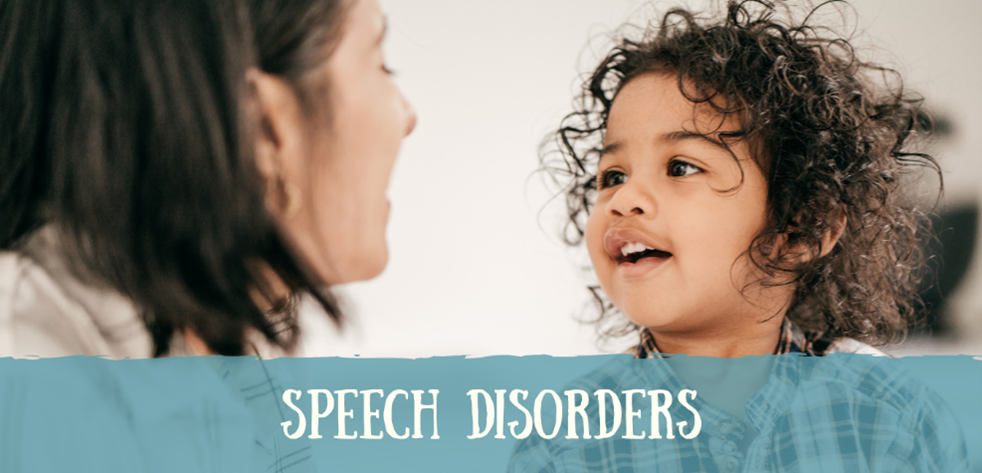
Speech sound disorders
Children may say some sounds the wrong way as they learn to talk. They learn some sounds earlier, like p, m, or w. Other sounds take longer to learn, like z, v, or th. Most children can say almost all speech sounds correctly by 4 years old. A child who does not say sounds by the expected ages may have a speech sound disorder. You may hear the terms “articulation disorder” and “phonological disorder” to describe speech sound disorders like this.
Childhood Apraxia of Speech
Apraxia of speech (AOS)—also known as acquired apraxia of speech, verbal apraxia, or childhood apraxia of speech (CAS) when diagnosed in children—is a speech sound disorder. Someone with AOS has trouble saying what he or she wants to say correctly and consistently. AOS is a neurological disorder that affects the brain pathways involved in planning the sequence of movements involved in producing speech. The brain knows what it wants to say, but cannot properly plan and sequence the required speech sound movements.

Auditory processing
People with auditory processing disorder (APD) have a hard time hearing small sound differences in words. Someone says, “Please raise your hand,” and you hear something like “Please haze your plan.” You tell your child, “Look at the cows over there,” and they may hear, “Look at the clown on the chair.”
APD, also known as central auditory processing disorder, isn’t hearing loss or a learning disorder. It means your brain doesn’t “hear” sounds in the usual way. It’s not a problem with understanding meaning. APD can affect the way your child speaks as well as their ability to read, write, and spell. They may drop the ends of words or mix up similar sounds.
It also can be hard for them to talk with other people. They may not be able to process what others are saying and come up with a response quickly.

Stuttering
Stuttering — also called stammering or childhood-onset fluency disorder — is a speech disorder that involves frequent and significant problems with normal fluency and flow of speech. People who stutter know what they want to say, but have difficulty saying it. For example, they may repeat or prolong a word, a syllable, or a consonant or vowel sound. Or they may pause during speech because they’ve reached a problematic word or sound.
Stuttering is common among young children as a normal part of learning to speak. Young children may stutter when their speech and language abilities aren’t developed enough to keep up with what they want to say. Most children outgrow this developmental stuttering within 6 months.
Sometimes, however, stuttering is a chronic condition that persists into adulthood. This type of stuttering can have an impact on self-esteem and interactions with other people.

Language delay
We use expressive and receptive language skills to communicate with others effectively. If a person has trouble understanding others or sharing thoughts, ideas and feelings, the person may have a language disorder. A language disorder can be a receptive or expressive language disorder.
Receptive language is the ability to understand and comprehend spoken language that you hear or read. For example, a child’s ability to listen and follow directions (e.g. “put on your coat”) relies on the child’s receptive language skills. Expressive language is the “output” of language, the ability to express your wants and needs through verbal or nonverbal communication. It is the ability to put thoughts into words and sentences in a way that makes sense and is grammatically correct. Children that have difficulty communicating their wants and needs may have expressive language difficulties or an expressive language disorder.

Literacy
Language is the foundation of all reading and writing. Phonological and phonetic awareness links language and literacy.
Difficulties in learning to comprehend and speak as well as difficulties in learning to read and write can involve one or more of the components of language—phonology (production of sounds), morphology (the study of the rules of meaningful units of language), syntax (the structure of language), semantics (the meaning of words), and pragmatics (the rules associated with the use of language in conversation).
Deficits can occur in the production, comprehension, and awareness of language at the sound, syllable, word, sentence, and/or conversational levels. SLT’s are trained in assessing and remediating not only speech and language, but also reading and writing skills.

Dyslexia
Dyslexia is a term used to describe a range of persistent difficulties with reading and writing, and often including spelling, numeracy or musical notation.
Students with dyslexia do not make expected progress in these areas in spite of good teaching and the type of extra support that would be helpful for most children. But difficulties with dyslexia can be reduced with effective individualised teaching and specialist support.
Autism Spectrum Disorder
Autism, or autism spectrum disorder (ASD), refers to a broad range of conditions characterized by challenges with social skills, repetitive behaviors, speech and nonverbal communication. Autism affects an estimate 1 in 44 children today.
We know that there is not one autism but many subtypes, most influenced by a combination of genetic and environmental factors. Because autism is a spectrum disorder, each person with autism has a distinct set of strengths and challenges. The ways in which people with autism learn, think and problem-solve can range from highly skilled to severely challenged. Some people with ASD may require significant support in their daily lives, while others may need less support and, in some cases, live entirely independently.